Software Engineering
Software that's still easy to change a year from now
Web, mobile, and backend platforms built to scale, with the tests, observability, and documentation that keep it maintainable long after we've handed it over.
Start BuildingThis is probably you if
- Your current system can't handle the growth you're actually planning for
- You've outgrown a no-code tool or an early MVP that was never meant to scale
- Two or more of your business systems don't talk to each other, and someone is manually reconciling the gap
- A previous engineering partner left you a system only they understood
- You need an honest technical opinion on a system someone else built, before committing further budget to it
- You need to move faster without quietly cutting corners on quality
What's included
- 01Web platforms, mobile apps, and backend systems, built in whichever ecosystem fits what you already run, whether that's a Node.js and TypeScript stack, a PHP and Laravel codebase, a .NET environment, or a Python-based platform, chosen for what serves your team and your growth plans, not for what we'd default to
- 02System integrations that connect the tools your business already depends on, so data stops needing to be manually reconciled between them
- 03Test coverage, CI/CD pipelines, and observability from day one, not a cleanup pass added before handover
- 04Infrastructure setup and management across AWS, Azure, or Google Cloud, containerized with Docker and orchestrated with Kubernetes where scale actually calls for it
- 05Documentation written for the team that inherits the system, not just for us
Our approach
- 01
Frame the problem
Agree in writing on what success looks like, what constraints are real, and what we're deliberately not building.
- 02
Prove the risky part first
Every project has one piece most likely to sink it: an unproven integration, a performance question that only shows up at scale. We build that piece first, while it's still cheap to change course.
- 03
Build in the open
Working software every week, not a status update about it. Feedback happens in days, not at the end of a silent six-week sprint.
- 04
Hand over cleanly
Tests, documentation, and a walkthrough with your team are part of the engagement, not an optional add-on at the end.
Sound like the help you need?
Start BuildingHow this compares
| Typical in-house hire | Freelance contractor | Hexary Labs | |
|---|---|---|---|
| Ramp-up time | Weeks to months before full productivity | Fast start, but variable depth | Fast start, senior from day one |
| Seniority on the work | Depends who you hire | Depends who you find | Senior engineers on every engagement, by design |
| Accountability if something breaks | Sits with one person | Often ends when the contract does | Sits with the team that built it, documented for handover |
| Documentation and handover | Varies by individual habits | Frequently the first thing skipped | Built into every engagement, not optional |
| Range of disciplines available | Whatever that hire specializes in | Usually one discipline at a time | Strategy, design, engineering, and AI, on the same team |
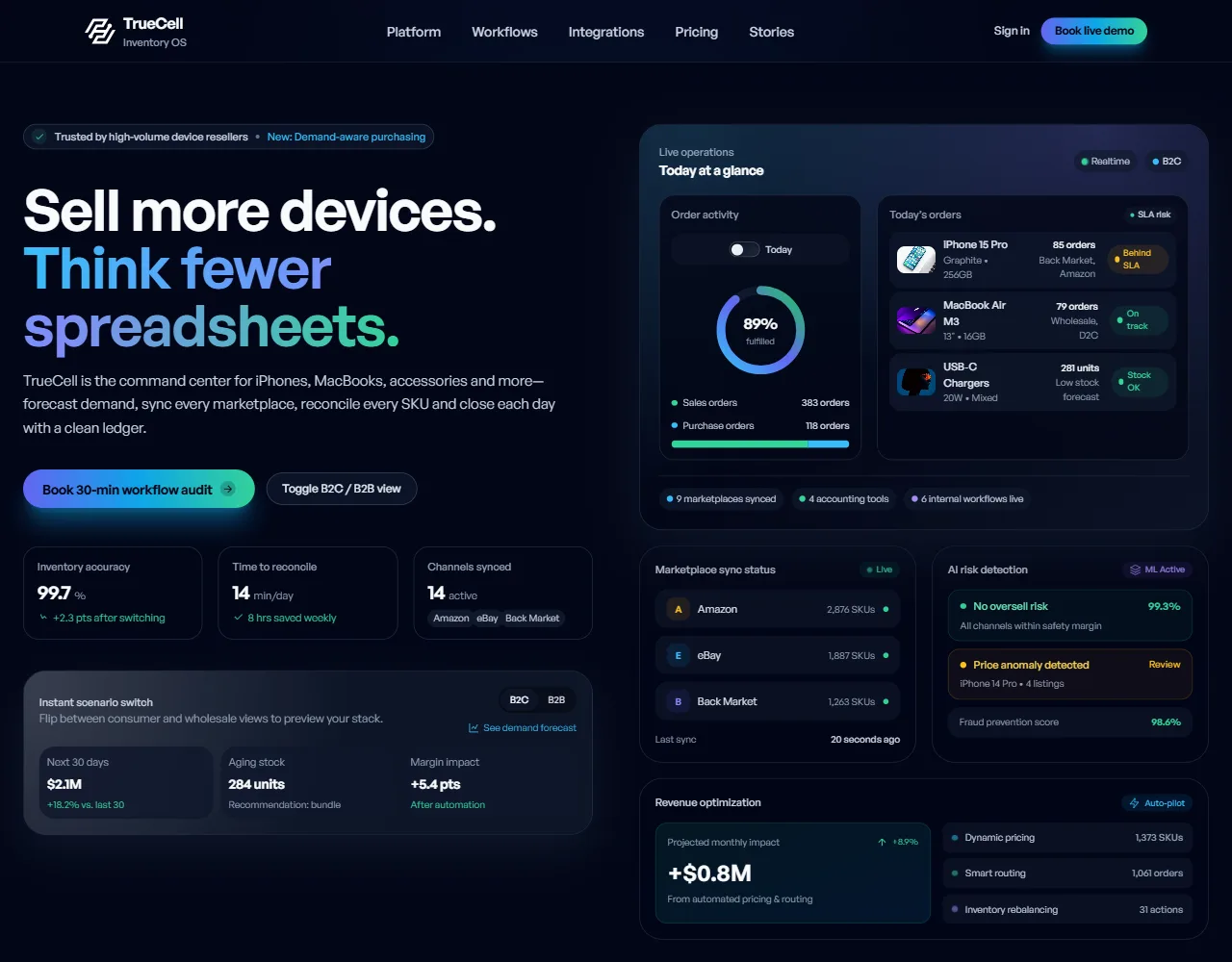
TrueCell
An inventory OS for high-volume electronics resellers: marketplace sync across Amazon, eBay, Back Market and more, demand forecasting, a rules engine that routes every unit without overselling it, and the accounting integrations to keep the books in agreement with the warehouse.
- Amazon
- eBay
- Back Market
- Shopify
- QuickBooks
- NetSuite
What you walk away with
- 01A system that scales without needing a rebuild in a year
- 02Integrations that stop requiring a person to manually reconcile the gap between two tools
- 03Faster release cycles, because tests and CI were built in from the start, not bolted on afterward
- 04A team that can actually maintain what we built, without calling us every time something breaks
The same team behind this service has built the inventory and marketplace-sync platform behind TrueCell, the bidirectional accounting integration behind Kinein, and the retailer-verification marketplace behind B2B Access, the kind of connective, integration-heavy work this service is built around.
FAQ
Do you work with our existing codebase, or only greenfield builds?
Both. A large share of our work is extending or modernizing an existing system rather than starting from zero.
We already have an in-house team. Can you work alongside them?
Yes, regularly. We're used to plugging into an existing team's workflow rather than replacing it.
What does "clean handover" actually include?
Tests, documentation written for your team specifically (not generic README notes), and a live walkthrough before we consider the engagement closed.
How do you handle support after launch?
That's scoped per engagement, from a defined warranty period to an ongoing retainer, depending on what the project actually needs.